
The Ethereum Foundation has completed a landmark staking initiative, depositing the bulk of its planned ETH staking commitment in a single session and finalising a program that was announced in February 2026. This Ethereum Foundation staking move — which transforms previously idle treasury holdings into yield-generating positions — is one of the most significant shifts in the Foundation’s approach to treasury management since Ethereum’s inception. The implications for ETH price dynamics, validator economics, and the broader Ethereum ecosystem are profound and deserve careful analysis.
What the Ethereum Foundation Staking Program Actually Entails
The Ethereum Foundation staking initiative represents a fundamental change in philosophy from the Foundation’s historically conservative approach to its ETH holdings. For years, the Foundation maintained large positions in unstaked ETH — a deliberate choice driven by concerns about conflicts of interest, the desire to maintain operational liquidity, and uncertainty about staking mechanics in the early years of Proof-of-Stake. The announcement in February 2026 that it would begin staking a significant portion of its treasury was itself a major story; the completion of that program now is the natural next chapter.
The Ethereum Foundation staking deposit is significant not just in absolute dollar terms but in the signal it sends to the market. When the organisation responsible for coordinating Ethereum’s technical development publicly commits to staking ETH, it represents an institutional vote of confidence in the network’s security model, validator economics, and long-term sustainability. Every validator operator, institutional staker, and retail ETH holder receives an implicit signal: the stewards of Ethereum trust the system they’ve built enough to put their treasury inside it.
The Ethereum Foundation staking program also has direct economic consequences. By removing a large tranche of ETH from the circulating tradeable supply and locking it in the staking contract, the Foundation has modestly tightened the effective supply of ETH available for spot trading. In an environment where ETH demand from DeFi, layer-2 activity, and institutional buyers remains steady, this supply reduction is incrementally bullish for price — a small effect individually, but meaningful in combination with other supply-constraining forces like EIP-1559 fee burning.
The specific mechanics of the Ethereum Foundation staking deposit matter too. The Foundation chose to deposit via the standard staking contract rather than through a liquid staking protocol like Lido or Rocket Pool — a choice that likely reflects the Foundation’s preference for supporting native network infrastructure over adding systemic risk through intermediary protocols. This decision also means the Foundation will not receive liquid staking tokens (like stETH) that could be used in DeFi, further removing the deposited ETH from circulation.
Ethereum Staking Economics: What the Foundation’s Move Tells Investors
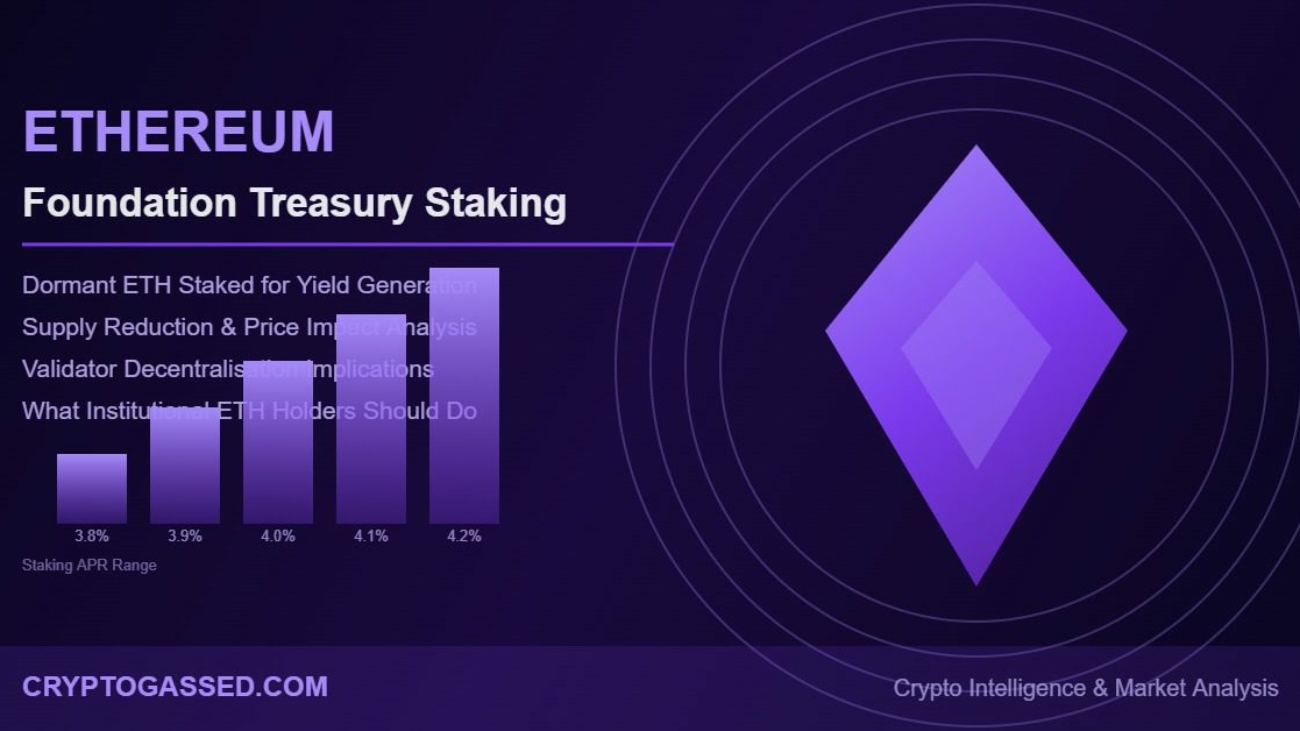
The Ethereum Foundation staking decision comes at a moment when ETH staking economics are particularly favourable. The current annualised staking yield on Ethereum is approximately 3.8–4.2%, derived from a combination of block rewards (newly issued ETH), priority fees from transaction inclusion, and MEV (Maximal Extractable Value) captured by validators. This yield compares favourably to many traditional fixed-income instruments and provides a compelling reason for long-term ETH holders to stake rather than hold idle.
The Ethereum Foundation staking completion signals that the Foundation has concluded that the staking yield adequately compensates for the illiquidity of locked ETH — an assessment that many institutional investors share. The staking yield also effectively sets a floor on the “opportunity cost” of not staking ETH, which influences how much of the total supply is staked at any given time. Currently, approximately 28% of all ETH is staked — a figure that has grown steadily since the merge and is expected to continue increasing as staking infrastructure matures.
Higher staking participation rates have a complex effect on Ethereum Foundation staking yield dynamics. As more ETH is staked, the per-validator reward decreases (since the same pool of rewards is distributed across more validators), which mathematically reduces the staking APR. However, higher staking rates also tighten the effective circulating supply, which is supportive of price. The Ethereum Foundation staking move contributes to this dynamic on both sides: it increases total staked ETH (marginally diluting per-validator rewards) while simultaneously reducing liquid supply (supporting price).
The Ethereum Foundation staking program is particularly noteworthy in the context of Ethereum’s broader supply mechanics. Since EIP-1559 introduced fee burning in August 2021, a portion of every Ethereum transaction fee has been permanently destroyed. During periods of high network activity, Ethereum has become net deflationary — more ETH is burned than is issued. While the current lower-fee environment means Ethereum is modestly inflationary on a net basis, the combination of fee burning, staking lockup, and now the Ethereum Foundation staking commitment creates a multi-layered supply constraint that is structurally supportive of ETH price over the medium to long term.
How the Ethereum Foundation Staking Move Affects Validator Decentralisation
One important dimension of the Ethereum Foundation staking decision is its effect on validator set composition and network decentralisation. Ethereum’s long-term security depends on a diverse, geographically distributed, and economically diverse set of validators. The concentration of staking among a small number of liquid staking protocols — particularly Lido, which controls over 30% of all staked ETH — has been a persistent concern among Ethereum researchers and developers.
By choosing to stake through the native mechanism rather than through a liquid staking provider, the Ethereum Foundation staking initiative marginally improves validator diversity. It adds a set of validators controlled by the Foundation itself, which operates with different incentives and governance structures than profit-motivated staking pools or liquid staking protocols. This is a small but symbolically important contribution to decentralisation.
The Ethereum Foundation staking choice also creates a mild counter-narrative to concerns about Lido’s market dominance. If the Foundation — which has historically been vocal about concerns regarding staking concentration — is comfortable staking natively rather than contributing to Lido’s TVL, it sends a signal that solo staking and native staking remain viable and preferred options for long-term ETH holders. This may encourage other large ETH holders to follow the Foundation’s example.
Ethereum researchers have proposed various mechanisms for limiting liquid staking protocol dominance, including social consensus norms and potential protocol-level interventions if any single provider exceeds a certain threshold. The Ethereum Foundation staking through native infrastructure is consistent with these efforts and demonstrates that the Foundation is willing to walk the walk, not just talk the talk, on decentralisation.
Market Impact: How ETH Price May Respond to Foundation Staking
The immediate price impact of the Ethereum Foundation staking completion has been muted, partly because the program was announced in February and the market had time to price in the expected supply reduction. The classic market principle of “buy the rumour, sell the news” applies here — much of the positive sentiment was absorbed when the program was announced, meaning the completion itself produces less incremental price movement.
However, the Ethereum Foundation staking completion may have longer-term price effects that are not yet visible. As the staked ETH is withdrawn from circulation and the yield begins accruing, the ongoing supply reduction compounds over time. Unlike a one-time event, staking locks up ETH continuously — the longer the Foundation maintains its staking position, the greater the cumulative supply effect.
The Ethereum Foundation staking move also provides a narrative catalyst that could attract additional institutional stakers. Asset managers, hedge funds, and corporate treasuries that have been evaluating ETH staking as a yield-generating strategy may interpret the Foundation’s completion of its program as a green light — a validation from the highest authority in the Ethereum ecosystem that staking is a prudent approach to ETH treasury management.
ETH price at the time of this writing sits around $2,800–$3,000 based on recent market data, with the broader market under pressure from the same macro headwinds affecting Bitcoin. The Ethereum Foundation staking completion does not change these macro dynamics, but it strengthens the fundamental case for ETH appreciation once macro conditions improve and institutional demand for yield-bearing crypto assets resumes its growth trajectory.
The Ethereum Ecosystem in 2026: Foundation Staking in Context
The Ethereum Foundation staking program should be understood as part of a broader narrative of Ethereum ecosystem maturation in 2026. The layer-2 ecosystem — including Arbitrum, Optimism, Base, and zkSync — has grown dramatically, with combined TVL exceeding $30 billion and daily transaction volumes that rival or exceed Ethereum mainnet. This layer-2 growth has been both a feature and a challenge for Ethereum: it demonstrates the ecosystem’s scalability, but it also reduces mainnet fee pressure, limiting the deflationary effect of EIP-1559 burning.
The Ethereum Foundation staking decision reflects confidence that Ethereum’s future is not threatened by this layer-2 transition but rather defined by it. As execution moves increasingly to L2s, Ethereum mainnet becomes the settlement layer and data availability layer — a role that generates more stable, predictable fees even if individual transaction costs are lower. The Ethereum Foundation staking yield will be supported by this fee structure over the long term, regardless of whether individual transactions occur on mainnet or on rollups that periodically settle to mainnet.
DeFi activity on Ethereum and its L2s hit $87.2 billion in TVL as of early April 2026, though it has declined modestly in the current risk-off environment. The Ethereum Foundation staking program positions the Foundation to benefit from DeFi’s recovery and growth — as network activity increases, staking yields improve through higher priority fees and MEV, making the Foundation’s staking position more profitable over time.
Conclusion: The Ethereum Foundation Staking Move Is a Bet on Ethereum’s Future
The Ethereum Foundation staking completion is, at its core, a statement of confidence. It says: we believe Ethereum’s validator economics are sound, its security model is robust, and its long-term future as the world’s programmable financial infrastructure is secure enough to warrant putting our treasury inside it. That statement carries enormous weight in the crypto ecosystem, where the Foundation’s technical credibility and moral authority are unmatched.
For ETH investors, the Ethereum Foundation staking program is a bullish fundamental development that should be tracked and understood in its full complexity. It tightens supply, validates staking economics, supports validator diversity, and provides a template for institutional ETH holders to follow. [INTERNAL_LINK] In the short term, macro conditions may dominate ETH price action. But the Ethereum Foundation staking commitment is one of many structural factors building the foundation for ETH’s next major price appreciation cycle.


Leave A Comment